Gate Phaser
Gate Phaser
Section titled “Gate Phaser”What would Steve Reich do if he had a EuroPi?
Gate Phaser creates 6 gates that drift in and out of phase with each other over time.
You can use this script to create Piano Phase type patches, dynamic rhythms which evolve over time and eventually resolve back in phase, or… well lots of other things that would benefit from having gates which are delayed from each other.
Demo Video
Section titled “Demo Video”https://www.youtube.com/watch?v=fnpH8Q6sxIM
Inputs, Outputs and Controls
Section titled “Inputs, Outputs and Controls”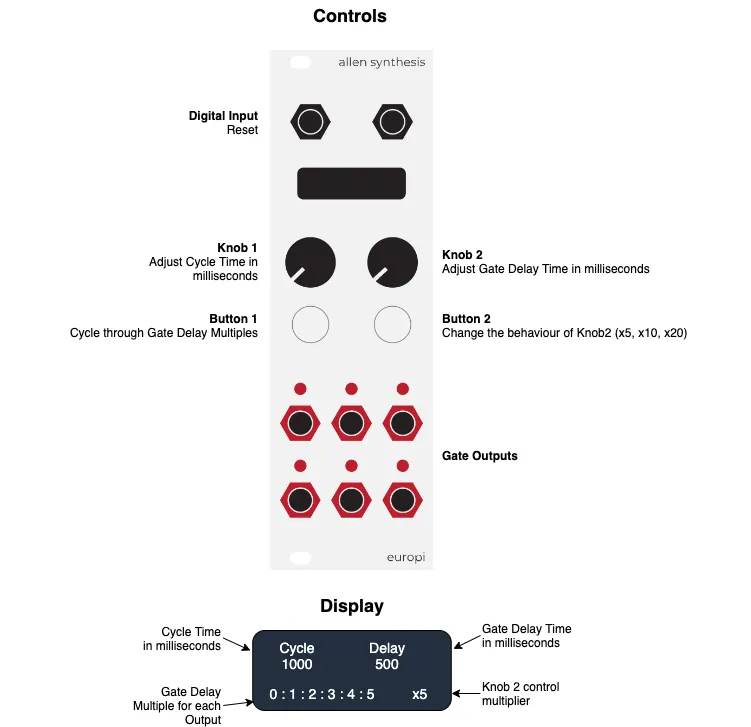
din: resetain: not usedk1: adjust cycle time in millisecondsk2: adjust gate delay time in millisecondsb1: cycle through gate delay multiple optionsb2: change the behaviour of knob2 (x5, x10, x20)cv1-cv6: output gates
Getting started
Section titled “Getting started”- Patch anything you want to trigger with a gate to any of the outputs, for example percussions elements, emvelopes, sequencer clocks or samples.
- Set the Cycle time in milliseconds using knob 1
- Set delay time in milliseconds using knob 2
- Set the desired gate delay interval using button 1
- Use button 2 to change the behaviour of knob 2 to set the desired gate delay time
So what is this script actually doing?
Section titled “So what is this script actually doing?”Cycle time is the time in milliseconds between gate outputs at output 1 when the gate delay multiple for output 1 is set to 0. When gate delay multiples are set to value greater than 0 the cycle time will be increased by the gate delay time multiplies by the gate delay multiple.
Gate delay is the time in milliseconds that gate outputs are delayed from the master cycle time.
Gate multiples are multiples of the gate delay time per output.
For Example:
Section titled “For Example:”- Cycle Time: 1000ms
- Gate Delay Time: 500ms
- Gate Delay Multiples: 0:1:2:3:4:5
The initial output is sent after “Gate Delay Time * Gate Delay Multiple” milliseconds. Each subsequent output is sent after “Cycle Time + (Delay Time * Gate Delay Multiple)” milliseconds.
Therefore after the initial gate output from each output:
- Output 1 sends a gate every 1000ms
- Output 2 sends a gate every 1500ms
- Output 3 sends a gate every 2000ms
- Output 4 sends a gate every 2500ms
- Output 5 sends a gate every 3000ms
- Output 6 sends a gate every 3500ms
Which results in the following:
| Output | t0 | 500ms | 1000ms | 1500ms | 2000ms | 2500ms | 3000ms | 3500ms | 4000ms |
|---|---|---|---|---|---|---|---|---|---|
| 1 | x | x | x | x | x | ||||
| 2 | x | x | x | ||||||
| 3 | x | x | |||||||
| 4 | x | x | |||||||
| 5 | x | ||||||||
| 6 | x |